


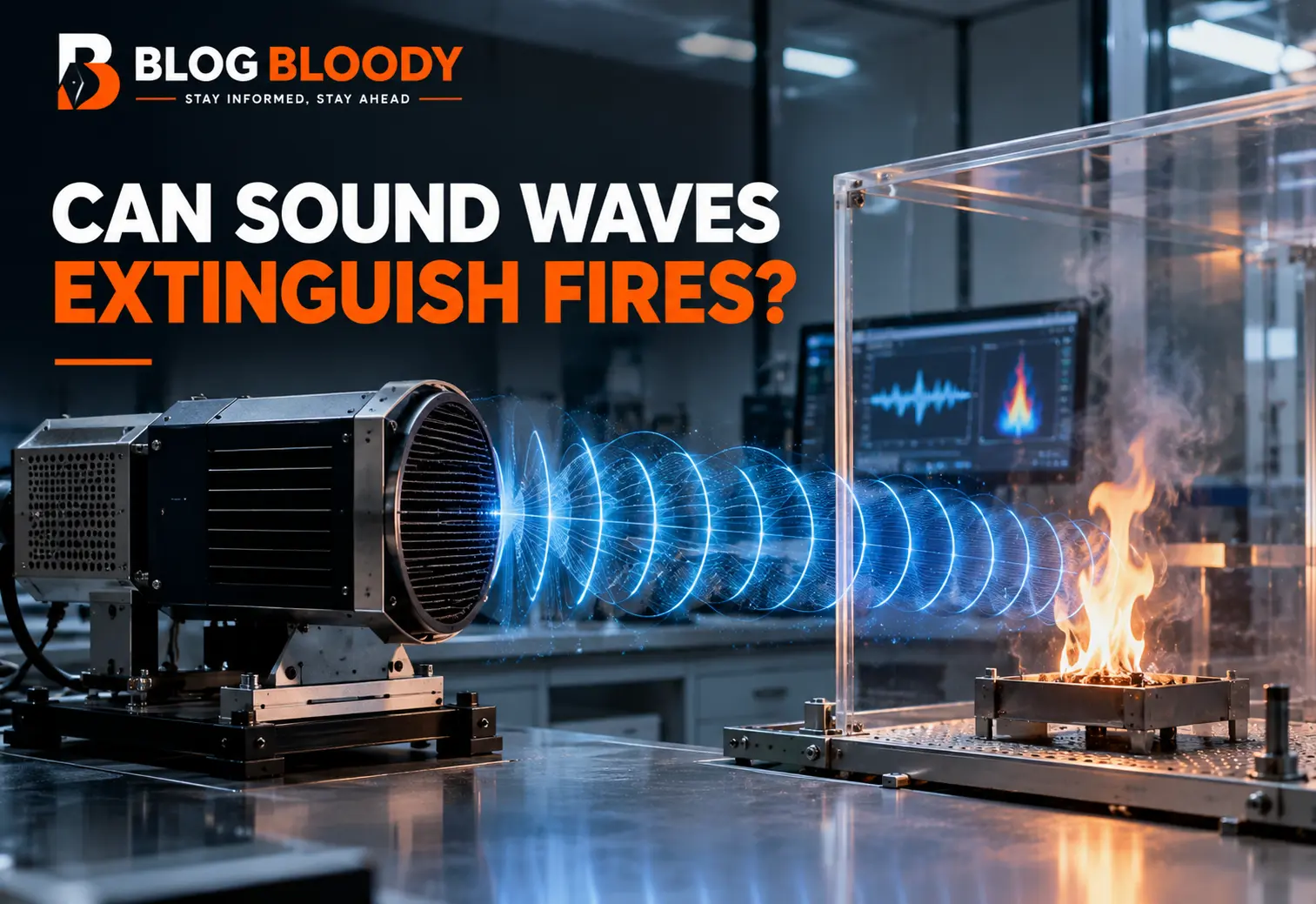
Can sound waves extinguish fires? Yes. Sonic fire suppression uses specially generated acoustic waves to extinguish small flames under controlled laboratory conditions. However, this technology is not yet a practical replacement for conventional fire extinguishers.
Known as sonic fire suppression, this experimental technique uses powerful sound waves and the airflow they generate to disturb a flame until combustion stops. Scientists are investigating whether it could eventually support fire safety in specialized environments, including industrial facilities where conventional extinguishing agents may create practical difficulties.
Research published in February 2026 demonstrated the extinguishing of small candle flames using a high-power acoustic device at a distance of 50 centimetres. A separate study published in October 2026 investigated how airflow generated by sound sources affects flame behaviour. These findings demonstrate progress while highlighting the engineering challenges that remain.
Sources: Sensors, 2026 and Fuel, 2026.
What Is Sonic Fire Suppression?
Sonic fire suppression is an experimental fire-control technique that uses acoustic energy to disturb flames. Conventional fire extinguishers use agents such as water, carbon dioxide, foam, or dry chemicals, depending on the type of fire. Acoustic systems work differently. They use sound-generating equipment to produce pressure variations and airflow around a flame.
These disturbances can affect heat transfer, fuel vapour movement, and the supply of oxygen within the combustion zone. The objective is to destabilize the flame until it can no longer sustain combustion.
Researchers are interested in this approach because an acoustic device does not need to discharge a conventional extinguishing agent during operation. However, it still requires electricity, specialized equipment, and carefully controlled operating conditions.
How Does Sonic Fire Suppression Work?
Fire depends on several conditions, including fuel, heat, and oxygen. Sonic fire suppression attempts to disrupt the conditions that allow a flame to keep burning.
1. Sound Generates Air Movement
One important mechanism is airflow produced by a vibrating speaker diaphragm. When an acoustic device generates powerful, low-frequency waves, the diaphragm moves rapidly and can produce oscillating airflow. This movement may push a flame away from its fuel source or disrupt the surrounding gas flow.
A 2026 study published in Fuel investigated airflow generated by sound sources and its effects on diffusion flames. This distinction matters because a flame does not necessarily disappear simply because it is exposed to loud sound. The airflow created by the sound-generating equipment can be an important part of the extinguishing process.
2. Low Frequencies Can Disturb the Flame
Researchers are investigating different frequencies and waveforms to determine which combinations work best.
Low-frequency sound is particularly interesting because it can produce substantial movement from a speaker diaphragm. That movement may disturb a flame’s shape and interrupt the stable flow of fuel and air.
However, lower frequencies are not automatically better in every situation. Results depend on the device design, flame type, distance, acoustic conditions, and surrounding airflow.
3. The Flame Loses Stability
When airflow repeatedly deflects a flame, combustion can become unstable. If the flame is displaced sufficiently from its fuel supply, it may no longer receive the conditions needed to continue burning. The flame can then extinguish.
The challenge is to generate enough disturbance without creating additional hazards or spreading burning material.
What Does the Latest Research Show?
Recent experiments help explain what sonic fire suppression can achieve under controlled conditions.
A High-Power Acoustic Extinguisher Tested in 2026
In a study published in Sensors in February 2026, researcher Jacek Łukasz Wilk-Jakubowski examined a high-power acoustic extinguisher using small paraffin candle flames.
The experimental setup placed a flame approximately 50 centimetres from the device. Researchers tested different fundamental frequencies, power levels, and waveform harmonics.
For one configuration operating at a fundamental frequency of 14 Hz, with harmonics extending to the tenth order, the study reported a sound pressure level of 125.6 dB at the extinguishing location and an electrical input power of 390 watts.
The researchers also reported that the required power increased at higher fundamental frequencies within the tested configurations.
These findings highlight an important limitation: extinguishing a small flame can require substantial equipment and energy. The results do not establish that the same device can extinguish a room fire or a fire involving burning solid materials.
Read the original study in Sensors.
A New Study Examines Airflow Near Sound Sources
A study published in Fuel on October 1, 2026, examined how airflow generated by sound sources affects diffusion flames.
The researchers investigated acoustic and flow characteristics alongside changes in flame shape. The study highlighted the role of airflow generated by a vibrating speaker diaphragm in disturbing combustion.
This research is relevant because it shifts attention beyond sound frequency alone. The design of the sound source, the airflow it generates, and the position of the flame can all influence performance.
The findings may help researchers design more effective acoustic fire-control devices, but further testing is necessary before the technology can be relied upon in real emergencies.
Read the October 2026 study in Fuel.
What Are the Potential Benefits of Sonic Fire Suppression?
If researchers overcome the current limitations, acoustic fire suppression could offer several advantages in specialized applications.
- No discharged extinguishing agent: An acoustic device can operate without releasing water, foam, or extinguishing powder.
- Potentially reusable operation: The device can generate sound repeatedly while it has a suitable power supply.
- Remote flame control: A properly designed device might target a small flame without requiring an operator to approach it closely.
- Integration with sensors: Cameras and other detection systems could help identify flames and direct acoustic output toward them.
- Specialized industrial applications: Researchers could investigate its use in environments where conventional extinguishing agents present practical challenges.
These remain potential advantages rather than proven commercial benefits. Acoustic systems must demonstrate reliable performance, acceptable noise exposure, and effective control across their intended fire types.

Why Sonic Fire Suppression Is Not Ready to Replace Fire Extinguishers
Although laboratory results are promising, significant technical challenges remain.
Large Fires Are More Difficult to Control
A candle flame is much easier to disrupt than a burning room, warehouse, or forest.
Large fires involve multiple fuel sources, greater heat output, changing air currents, and potentially dangerous smoke. A device that extinguishes a small flame may not generate enough disturbance to control a larger fire.
Different Fuels Behave Differently
The response of a flame depends on its fuel and combustion conditions.
A small gas flame may respond differently from a liquid-fuel fire or burning wood. Solid materials can also continue smouldering or release flammable gases after visible flames disappear.
Researchers therefore need to test different fuels and fire sizes before acoustic equipment can be considered suitable for broader applications.
Sound Levels and Equipment Power Create Risks
Producing sufficient acoustic energy can require high-power equipment and extremely loud sound levels.
The 2026 research suggests that both sound pressure and electrical power must be considered when assessing performance. Equipment must also withstand heat and operate reliably under emergency conditions.
A device that extinguishes a flame in a controlled experiment is not automatically safe for use around people or in occupied buildings.
Where Could Sonic Fire Suppression Be Used?
Future applications might include specialized industrial environments, automated fire-control systems, and locations where conventional extinguishing agents present practical difficulties.
For example, researchers could investigate combining acoustic devices with cameras that detect small flames. A control system might identify a flame, direct acoustic output toward it, and verify whether the flame disappears. Such systems would require reliable detection, a fast response, and safeguards against failure.
Another possibility is combining acoustic technology with established fire-suppression methods. Rather than relying entirely on sound, a system might use acoustic disturbances alongside water mist or another appropriate extinguishing agent.
These possibilities require further testing. They should not be treated as commercially proven solutions for protecting homes or industrial facilities.
Should You Use Sound Waves to Put Out a Fire at Home?
No. Experimental sonic fire suppression is not a substitute for a certified fire extinguisher or an emergency response. Do not rely on loudspeakers, mobile phone applications, or homemade acoustic devices to handle an actual fire. They may fail to extinguish the flames, delay evacuation, or allow the fire to spread.
Use a fire extinguisher appropriate for the type of fire only when it is safe to do so and you have a clear escape route. If a fire is spreading, conditions are dangerous, or you are unsure whether you can control it, alert others, evacuate, and contact local emergency services.
Sonic fire suppression remains a research technology. Its future value will depend on reliable testing, engineering improvements, and appropriate safety standards.
Final Thoughts
Can sound waves extinguish fires? Yes, researchers have demonstrated this effect on certain small flames under controlled experimental conditions.
The technology involves more than simply making a loud noise. Acoustic equipment can generate airflow that disturbs a flame, displaces it from its fuel supply, and interrupts combustion.
Research published in 2026 continues to investigate which frequencies, waveforms, and device designs produce effective results. However, limitations involving fire size, fuel type, sound exposure, and equipment power remain significant.
For now, sonic fire suppression is best understood as an emerging technology that may eventually complement established fire-control systems. Its development is worth watching, but conventional fire-safety equipment remains essential.
Contact Us: Blogbloody
Write For Us: info@blogbloody.com